AI at Work
For employees: using artificial intelligence to do your job better without putting your employer or yourself at risk.
Making you the one who gets things done
AI at work isn’t about replacing you — it’s about making you the person who gets things done clearly and quickly. This page has two parts: one for people employed in a business or organisation, and one for those working for themselves.
For employees — get better at your job
Record and summarise meetings
Record the audio of a meeting; AI produces a summary and minutes that go out to everyone by email. And there’s a quiet advantage here — the one who writes, stays. Whoever writes the summary shapes what is recorded and how, which gives you influence and visibility in the team. (Be fair about it: always tell people beforehand that the meeting is being recorded.)
Better emails and reports, faster
Clear emails, status reports, memos — in minutes instead of an hour. You come across as more professional without spending more time.
Make complicated things simple
A difficult instruction, a technical document, a spreadsheet — AI helps you understand it and summarise it simply for colleagues.
Become known as the one who makes things clear
The person who summarises meetings, produces good documents and communicates clearly gets noticed. AI helps you step into exactly that role.

For the self-employed & professionals
Invoices and quotes almost by themselves
Your AI already knows your invoice template. At the client, you just say what’s being charged — and the finished invoice, with a cover note, is sitting in your outbox, ready to check and send. It saves time every day and looks professional.
Customer communication & follow-up
Quotes, reminders, replies to enquiries — fast, polite and consistent.
New kinds of work AI makes possible
Programming — simple apps, tools and automations, even without years of training. Websites — build them for small businesses. Marketing — social media, ad copy, campaigns, graphics. Design — logos, flyers, presentations.
A worked example: the invoice
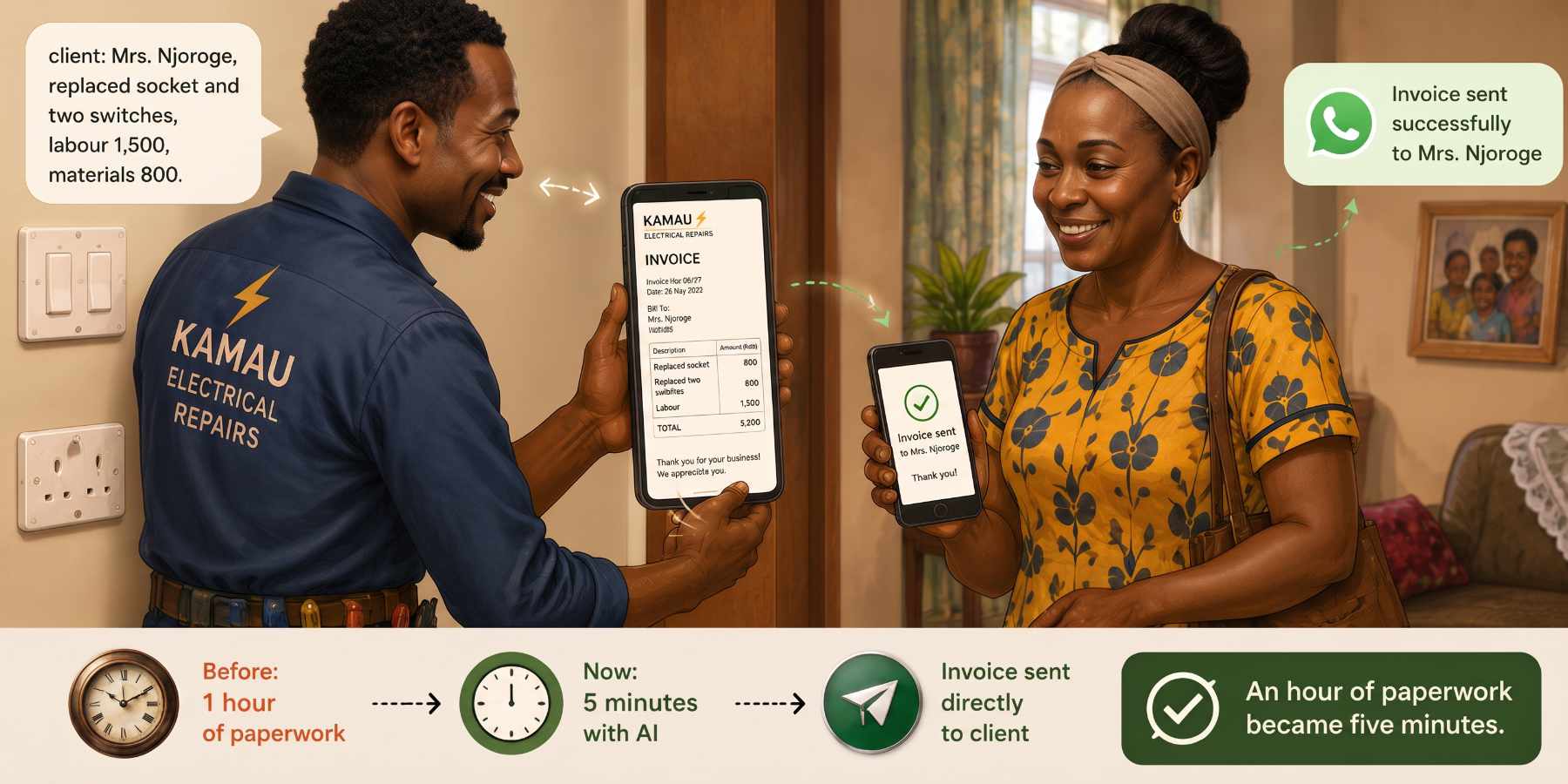
Kamau’s electrical repair business
Kamau runs a small electrical repair business. He used to spend an hour every evening writing invoices. Now his AI already knows his invoice template. After a job, he just tells it “client: Mrs. Njoroge, replaced socket and two switches, labour 1,500, materials 800.” Minutes later the finished invoice — with a polite cover note — is sitting ready. He checks it, sends it, done. An hour of paperwork became five minutes.
Useful prompts
Meeting summary
“Here is the transcript / my notes from a meeting [paste]. Write clear minutes: the main decisions, who is responsible for what, deadlines, and any open questions. Keep it short and neutral.”
Set up an invoice template
This is how my invoices look [paste or describe your template]. From now on, when I give you the client name and the work done, produce a finished invoice in this format with a short, polite cover note.
How this fits our training
This page belongs to our practical AI training, which runs through institutions that already teach and continues after the course ends. See the AI overview or how to take part.
Shirikiana —> to work with one another. The founding values of the cooperative movement, self-help, self-responsibility and solidarity, remain the most practical basis for collective enterprise. We join knowledge, applied action and ethical responsibility in member-owned, member-governed enterprise, guided by the International Cooperative Alliance’s principle of concern for community. We proceed incrementally, attribute every partner by name, and distinguish demonstrated capacity from stated intent.