Practical AI Skills
What artificial intelligence can realistically do for a young person in Kenya, a cooperative or a small business — and what we teach.
What AI Is — and What It Isn’t
AI, and especially the kind behind chatbots (called Large Language Models), is a new way of working with a computer. It has read an enormous amount of what people have written, and it’s very good at recognising patterns in language, understanding what you mean, and giving you a clear answer on almost any topic.
But it helps to picture it correctly. Don’t think of AI as an all-knowing oracle. Think of it as an extremely well-read but inexperienced intern. It can recall facts, dates and words better than any person — but it has never lived in the real world, it lacks common sense about how things actually work, and it can’t always tell truth from a convincing-sounding guess. It’s brilliant with words, but it doesn’t understand the world the way you do.
Using It Well: Talking to It, and Checking It
To get the best out of these tools — and avoid their traps — you need two simple skills: how to talk to the AI, and how to judge its answers.

Ways to Use It
Typing
You type your question or instruction — the “prompt” — into the chat. The clearer and more specific you are, the better the answer. This is still the most precise way to guide it.
Talking
Many tools (like ChatGPT’s voice mode and Google Gemini) now let you simply speak to them. For Kenya this matters a lot: you can use AI while walking through the market, driving between towns, or working where typing isn’t practical. And it opens the door for people who are more comfortable speaking than typing.
The Epistemology of AI Responses – Trust, but Verify
Never Treat AI as an Authority
AI works by predicting what words most likely come next. Sometimes it “hallucinates” — it makes up facts, sources or figures that sound completely believable but are simply wrong, and it says them with full confidence. It can’t tell a trusted source from an internet rumour; it only knows what sounds right.
A Very Capable Assistant
The best way to think of AI is as a capable, tireless, but sometimes mistaken assistant. Its job is to help you — to gather information, get you past a blank page, write first drafts, and take care of tedious work. It supports your thinking; it doesn’t replace it.

You Stay in Charge
The final responsibility — for a letter, a budget, a marketing plan or a piece of code — is always yours. Important facts, legal points and money figures must be checked against a real source or a real expert. AI speeds up your work; it is not a substitute for professional judgement.
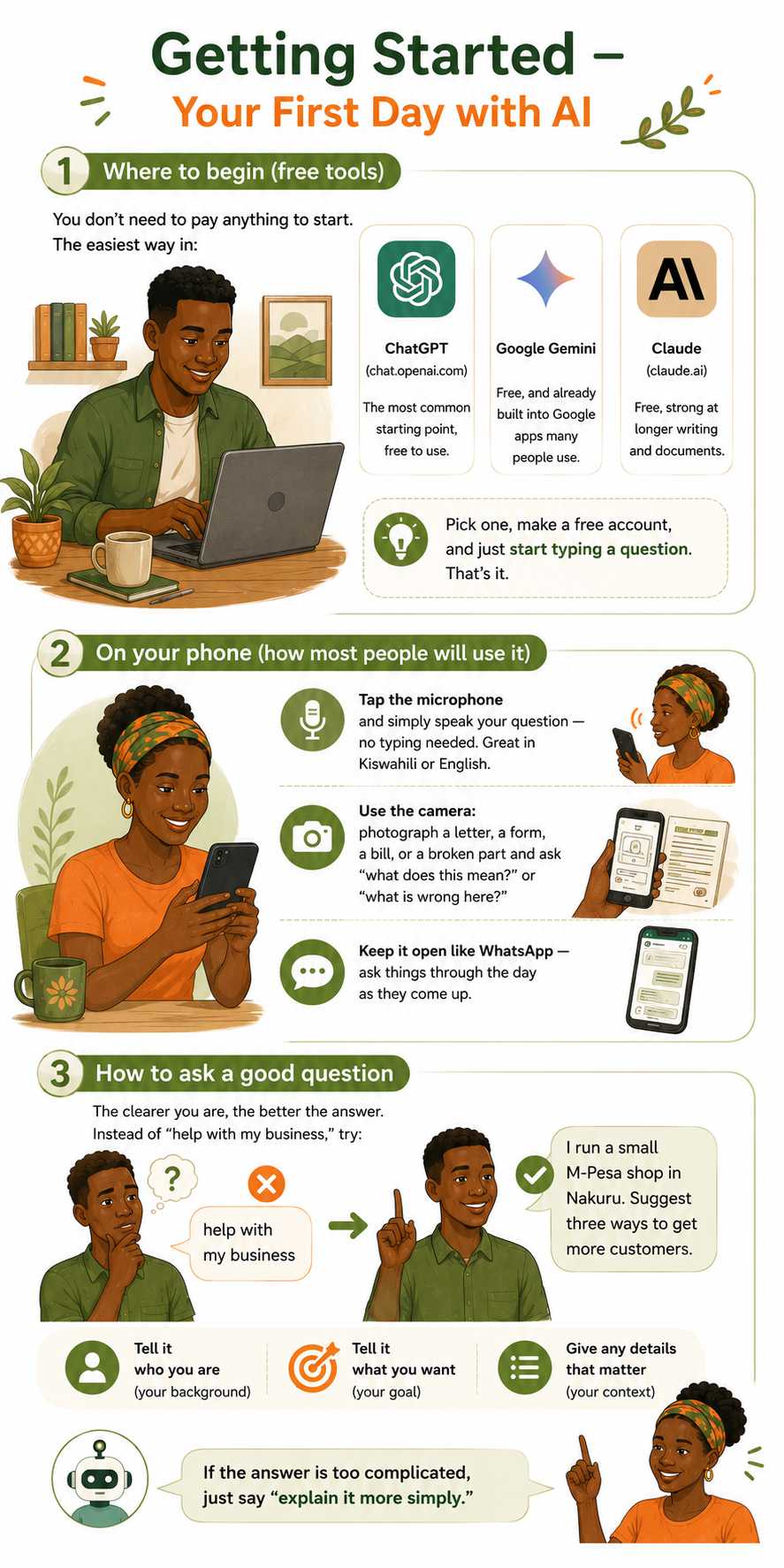
Getting Started — Your First Day with AI
On your phone (how most people will use it)
Where to begin (free tools)
You don’t need to pay anything to start. The easiest way in:
- ChatGPT (chat.openai.com) — the most common starting point, free to use.
- Google Gemini — free, and already built into Google apps many people use.
- Claude (claude.ai) — free, strong at longer writing and documents.
Pick one, make a free account, and just start typing a question. That’s it.

All three have free apps for Android and iPhone. Once installed:
- Tap the microphone and simply speak your question — no typing needed. Great in Kiswahili or English.
- Use the camera: photograph a letter, a form, a bill, or a broken part and ask “what does this mean?” or “what is wrong here?”
- Keep it open like WhatsApp — ask things through the day as they come up.
How to ask a good question
The clearer you are, the better the answer. Instead of “help with my business,” try: “I run a small M-Pesa shop in Nakuru. Suggest three ways to get more customers.” Tell it who you are, what you want, and any details that matter. If the answer is too complicated, just say “explain it more simply.”
Staying Safe — What Not to Share, and Avoiding Scams
Keep private things private
Whatever you type into a public AI tool may be stored and used to improve it. So don’t type in things you wouldn’t want seen:
- No M-Pesa PINs, passwords, or bank details.
- No ID numbers, KRA PIN, or full personal details of yourself or others.
- No private information about other people (patients, clients, members) without their permission.
If you need help with a real document, you can remove or change the sensitive numbers first, then ask.
Watch out for scams
AI makes some scams look more convincing — cleaner English, fewer mistakes. Stay alert:
- Be suspicious of any message asking for money, an M-Pesa payment, or a PIN, even if it looks official or well-written.
- AI can also help you here: paste a suspicious message and ask “does this look like a scam?”
- Remember AI can be confidently wrong. For anything important — money, health, legal, official — check with a real person or a trusted source before acting.
Where to Go From Here
The pages below take these ideas into one situation each. Pick the one closest to your own. If you would rather start with the tools themselves, the AI Models page explains what each model is built for and which ones you can run yourself.
Shirikiana —> to work with one another. The founding values of the cooperative movement, self-help, self-responsibility and solidarity, remain the most practical basis for collective enterprise. We join knowledge, applied action and ethical responsibility in member-owned, member-governed enterprise, guided by the International Cooperative Alliance’s principle of concern for community. We proceed incrementally, attribute every partner by name, and distinguish demonstrated capacity from stated intent.