Automation for Businesses
For owners and managers: where automation pays for itself in a small business, and where it quietly costs more than it saves.
Systems that work in the background
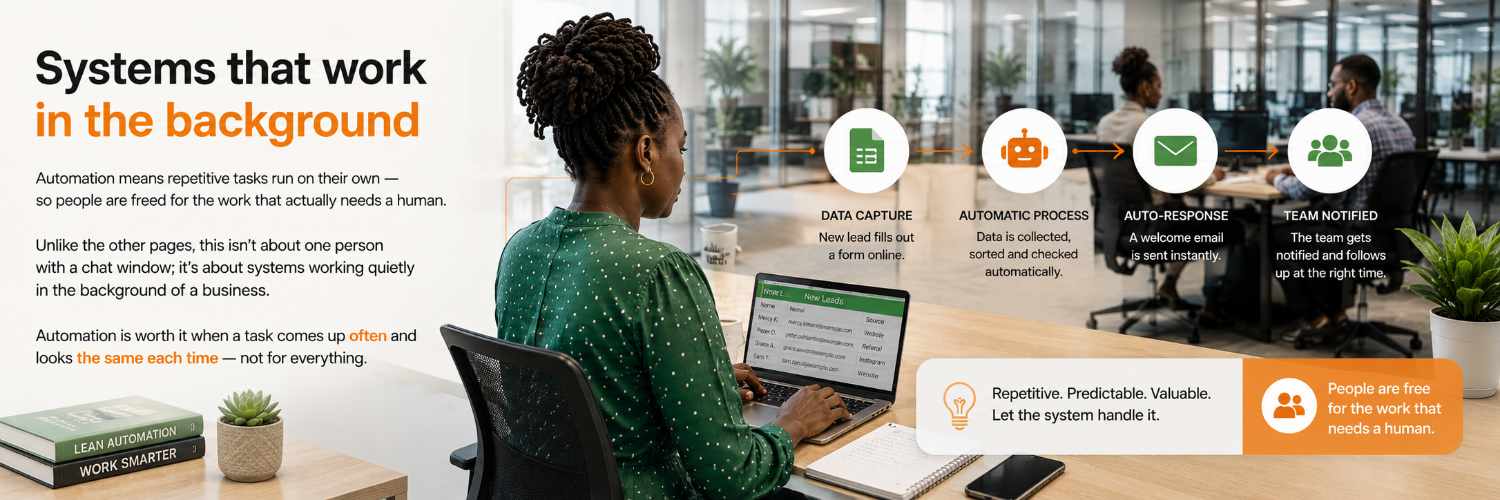
Automation means repetitive tasks run on their own — so people are freed for the work that actually needs a human. Unlike the other pages, this isn’t about one person with a chat window; it’s about systems working quietly in the background of a business. Automation is worth it when a task comes up often and looks the same each time — not for everything.
A phone service that never sleeps
An AI phone assistant switched on at peak times or overnight. It speaks several languages, knows the booking situation, can take reservations, answer questions and write a confirmation email. No more missed guest at 2 a.m. (Not only for hotels: also clinics, workshops, and restaurants with table reservations.)
Handling the flood of emails
Lots of similar enquiries: sorted, pre-answered, forwarded. AI suggests replies, a human checks and sends. Fifty emails in the morning become ten that truly need attention.
Orders and enquiries over WhatsApp
Very relevant in Kenya: a small business (restaurant, shop, delivery) takes orders over WhatsApp. AI receives them, confirms, and answers standard questions (“Are you open?”, “How much is delivery?”) automatically, around the clock.
Watching marketing campaigns
Is the advertising working? Which ad brings customers, which burns money? AI watches the numbers continuously and flags when something goes off track or does well — instead of someone checking dashboards by hand every day.
Appointments and reminders
Salon, clinic, workshop, tutoring: book appointments automatically and send reminders by SMS/WhatsApp. Fewer missed appointments, less idle time.
Stock and reordering
A shop is warned automatically when goods run low, and gets a ready-made reorder suggestion. Useful for M-Pesa shops, pharmacies and small stores.
Sorting receipts & bookkeeping
Receipts, invoices and expenses captured and sorted automatically for the books and for KRA — instead of a shoebox of receipts at year-end.
Reports that write themselves
A weekly sales report, a monthly overview — generated automatically from the data and emailed out. The manager gets the picture on Monday morning without anyone assembling it.
Social media on partial autopilot
Schedule posts, publish at set times, reply to standard comments. The human sets direction and approves; the execution runs on its own.
The honest frame
Automation doesn’t replace people, it relieves them. The AI phone service takes the night shift and the rush — the real, important conversations are still handled by a person. This isn’t about automating jobs away; it’s about freeing people from dull work.
The human stays in control. For anything that goes out (invoices, commitments, payments), a person checks before it’s sent.
We can help you set this up
Setting up automation well takes some technical work. Shirikiana and its partners can help a business or cooperative put these systems in place — so you get the benefit without having to build it yourself. Get in touch to talk it through.
How this fits our training
This page belongs to our practical AI training, which runs through institutions that already teach and continues after the course ends. See the AI overview or how to take part.
Shirikiana —> to work with one another. The founding values of the cooperative movement, self-help, self-responsibility and solidarity, remain the most practical basis for collective enterprise. We join knowledge, applied action and ethical responsibility in member-owned, member-governed enterprise, guided by the International Cooperative Alliance’s principle of concern for community. We proceed incrementally, attribute every partner by name, and distinguish demonstrated capacity from stated intent.